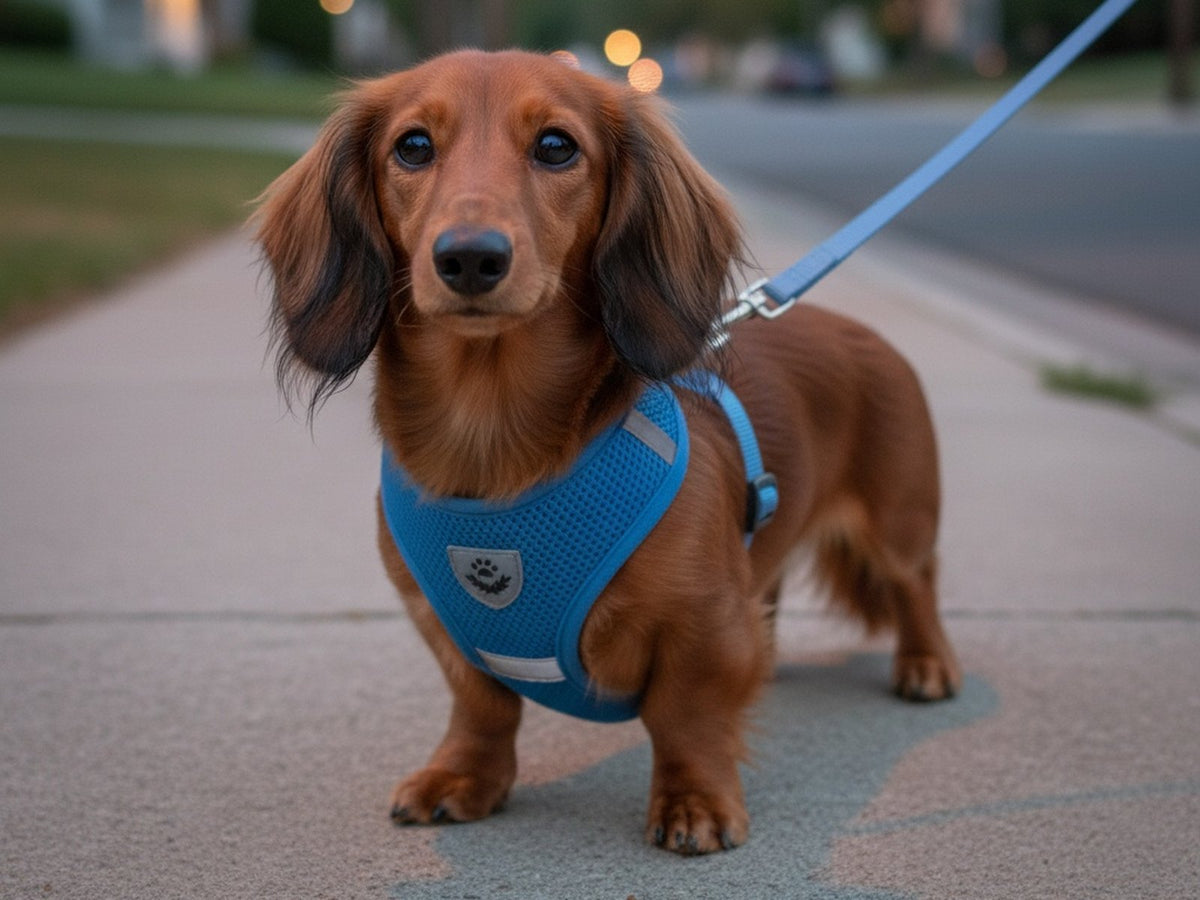
During the dark season, many dog owners are out at the same times: just before work, at lunchtime, after the working day. On narrow pavements and neighbourhood paths you therefore meet other dogs more often, and on the leash these moments are the biggest stress factor of the whole walk for many teams. The good news: relaxed encounters can be practised. With distance, a relaxed hand on the leash and good timing when rewarding, tense walk-pasts gradually become routine.
Why encounters on the leash are often difficult
Off the leash, dogs usually sort out encounters themselves: they approach in an arc, give way, sniff briefly and move on. On the leash, none of that is possible. Your dog can neither move aside nor increase the distance himself, and approaching head-on along the path feels rather rude from a dog's point of view. Add to that the tension that travels down the leash: if it goes tight, your dog immediately senses that you are tense.
Many owners know the result: staring, barking, lunging into the leash. It does not mean your dog is bad. Usually frustration or insecurity is behind it, and both respond well to training. Our Vico used to find oncoming dogs either thrilling or slightly scary depending on the day; today he simply walks past most of them.
Distance is your most important tool
Every dog has a distance at which he notices another dog but still stays calm. Your job is to know that distance and to make sure it is kept at every encounter. Depending on the dog, that can be a few metres or half a street's width.
- Walk an arc: Instead of passing the other dog head-on, give way in a gentle arc across the edge of the path or a patch of grass. It relaxes both sides.
- Change sides: Crossing to the other side of the street is not fleeing, it is good management.
- Use visual cover: A parked car, a hedge or a tree between the dogs makes passing much easier for many dogs.
- Keep moving: Walk on briskly and calmly. Standing still and watching often adds to the tension.
A loose leash and a calm you
During an encounter, shorten the leash but keep it free of tension. A tight leash transfers your own tension straight to your dog and takes away his last bit of freedom to move. Keep breathing calmly, talk to your dog in a normal tone and keep walking at your own pace. Your dog takes more cues from you than you might think: if you stay relaxed, it is easier for him to relax too.
Treats at the right moment
Treats are your best training tool during encounters, as long as the timing is right. Reward your dog as soon as he notices the other dog and then turns back to you, not only once he is already pulling into the leash. That way he learns: a strange dog appears, and good things happen next to you. How marker signals and timing work in detail is covered in our guide to rewarding in dog training.
For this to work, the treats have to be within reach in a split second. A treat pouch like the SnackPack (CHF 17.95) sits on your belt with its clip or hangs from the leash by its carabiner and opens with one hand. Small, firm treats that do not crumble and break easily are ideal, for example our crunchy sweet potato and coconut treats (CHF 15.00), vegan and handmade in Lugano.
What to avoid during encounters
- Forcing contact on the leash: "They just want to play" is rarely true on the leash. Only let dogs sniff if both owners agree and both dogs look relaxed.
- Scolding and leash jerks: Both link the other dog with something unpleasant and make the next encounter worse rather than better.
- Picking up as the standard solution: In an emergency, picking up a small dog is fine, but as a routine your dog learns nothing about walking past calmly.
- Constant feeding out of nervousness: A shower of treats with no link to behaviour calms you more than the dog. Reward deliberately, not indiscriminately.
If encounters regularly escalate
If your dog barks and lunges at almost every encounter even though you keep your distance, get support from a dog school or a dog trainer who works with rewards instead of punishment. Training sessions with calm, steady partner dogs often achieve more than any theory. And if your dog's behaviour changes suddenly and he is suddenly irritable with other dogs, a visit to the veterinary practice is worthwhile: pain can also be behind such changes.
You will find the right equipment for relaxed walks in our collection of dog collars, leashes & harnesses.
Frequently asked questions
Are dogs allowed to greet each other on the leash?
Better only as an exception: the leashes restrict body language and can get tangled. If both owners agree and both dogs look relaxed, a brief sniff of a few seconds is enough, then walk on in a friendly way.
What do I do if an off-leash dog runs towards us?
Stay calm, bring your dog to the side facing away from the other dog and ask the owner loudly and clearly to call their dog back. It often helps to scatter a handful of treats on the ground for the approaching dog: most dogs brake and sniff, and you gain time and distance.
Why does my dog only bark on the leash and hardly ever off it?
Off the leash, your dog can move aside and manage the distance himself; on the leash, that option is blocked. Barking and pushing forward are then often his attempt to keep the other dog at a distance. That is exactly why distance, walking an arc and good reward timing help the most.