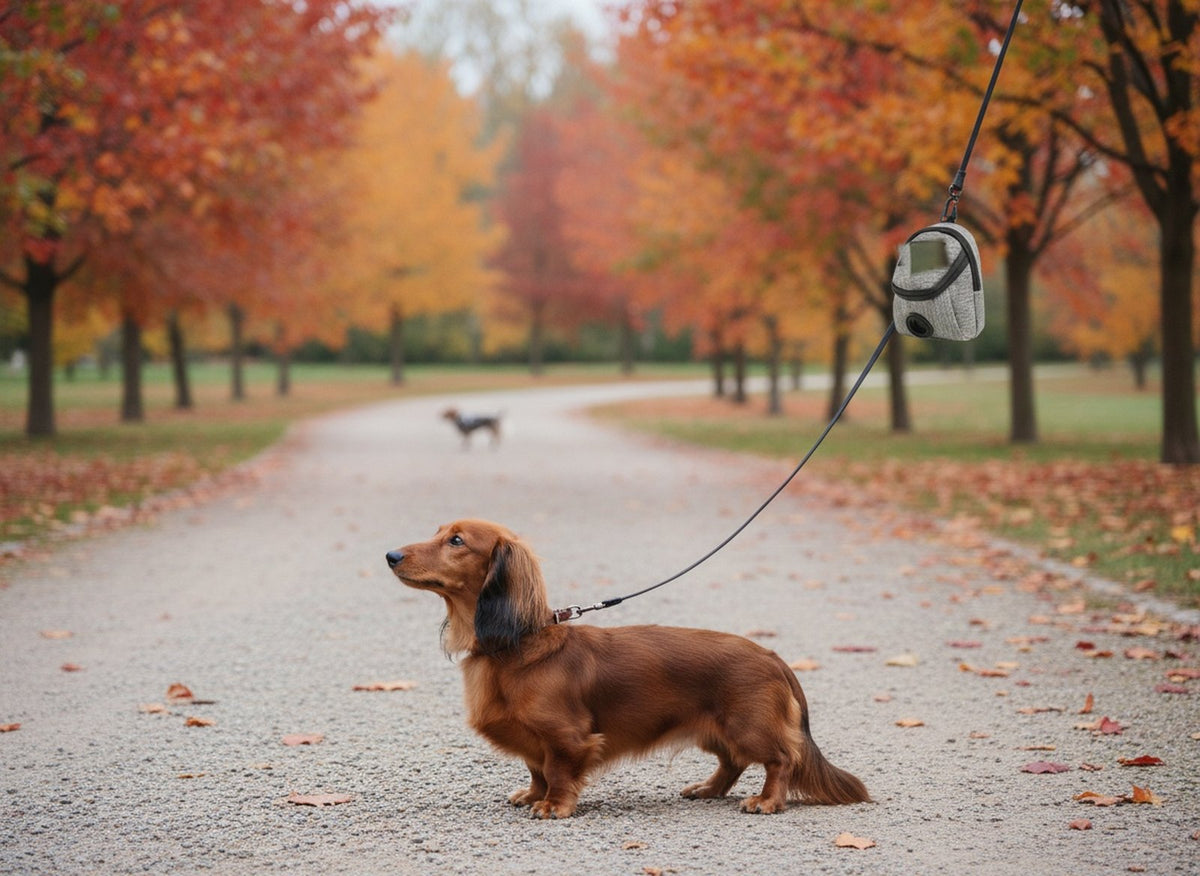
As soon as the evenings get darker, the question comes up again: should your dog walk on a harness or on a collar? Few topics are discussed as often among dog people, and both sides have good arguments. The short answer: it depends on your dog, and often the best solution is a combination of both.
In this article we look at what speaks for the harness, what speaks for the collar, and what to watch out for with fit, so that nothing presses or chafes.
What speaks for the harness
The most important difference is how the pull is distributed. On a collar, every tug acts directly on the neck, exactly where the larynx, windpipe and cervical spine sit. Vets point out that constant pulling on the neck can irritate these sensitive structures. With a chest harness, the same pull is spread across the ribcage and back, which are much more robust.
A harness is therefore the better choice for dogs that pull on the leash, for puppies in training and for small dogs, where even a little pull has a big effect. Escape artists are also more secure in a snug vest-style harness, because they can hardly wriggle out of it.
In the dark season, a model with reflectors is doubly worthwhile: the GlowWalk harness with leash is a soft mesh chest harness with a wide reflective band that throws headlight beams back. Your dog walks comfortably and is easier to see on the evening round.
What speaks for the collar
In everyday life, the collar is unbeatably practical: quickly put on, quickly taken off, and most dogs wear it without much getting used to. For dogs that have learnt to walk on a loose leash, a wide, well-fitting collar is perfectly fine on normal walks.
The strongest argument for the collar, however, is a different one: it is the place for your dog's contact details. If he ever gets lost, the ID tag often decides how quickly he gets back to you. On the VicoTrack collar with engraving, name and phone number are engraved directly on the tag, and the holder also has room for an Apple AirTag. That way your dog carries his contact details even when the leash is not attached.
The honest answer: usually both
For many dogs, the best solution is not either-or: the leash goes on the harness, and the collar with tag or engraving stays on the dog anyway. If he ever breaks free or slips out when the door opens, the collar makes him identifiable.
That is how we do it with our Vico: on the evening round he walks on his harness, but he always wears his engraved collar. With his long dachshund back, it matters to us that no tug goes onto his neck and spine. You can read more about protecting backs and joints in everyday life in our article Protecting your dog's joints.
The car is a special case: a dog seat belt always attaches to the harness and never to the collar, otherwise the full force acts on the neck when braking.
When the harness is clearly the better choice
- Your dog pulls on the leash: the pull is spread across the chest instead of the neck. The pulling itself is best trained away in parallel.
- Puppies and young dogs: they have not yet learnt leash manners, and their bodies are still growing.
- Small and narrow dogs: with little body weight, even light pulling acts strongly on the neck, and narrow heads slip out of a collar more easily.
- Coughing or gagging on the collar: switch to a harness and have persistent coughing checked at the veterinary practice.
- Long line and recall training: for safety reasons, a long line always attaches to the harness, never to the collar.
How the harness should fit
Measure your dog's chest girth at the widest point behind the front legs and compare it with the size chart on the product page. There should be room for two fingers between harness and body: tight enough that nothing slips, loose enough that nothing digs in. Make sure nothing chafes behind the front legs and the shoulders stay free to move.
Take your time for the first few sessions: let your dog sniff the harness, reward him with a treat and increase the wearing time slowly. At home, the harness can come off again, so it stays something special for walks and the coat is protected.
How the collar should fit
The two-finger rule applies to the collar too. At the same time, it must not slip over the ears when your dog pulls backwards. Check the fit regularly: young dogs grow, and in winter your dog carries more coat than in summer.
Whether harness, collar or both: you will find the right gear in our collection Dog collars, leashes & harnesses.
Frequently asked questions
What is better for dogs that pull hard?
A chest harness, because it spreads the pull across the chest and protects the neck. The harness does not solve the pulling, though: it pays to keep at it, for example with loose-leash exercises or support from a dog school.
Should my dog wear the harness all day?
No. The harness is meant for walks. Worn permanently, it can chafe and flatten the coat. The collar with tag or engraving, on the other hand, can stay on so your dog always carries his contact details.
Does my dog need a collar even with a harness?
A collar with contact details is very sensible, even when the leash is attached to the harness. If your dog ever gets lost, the engraved tag is often the quickest way back to you.